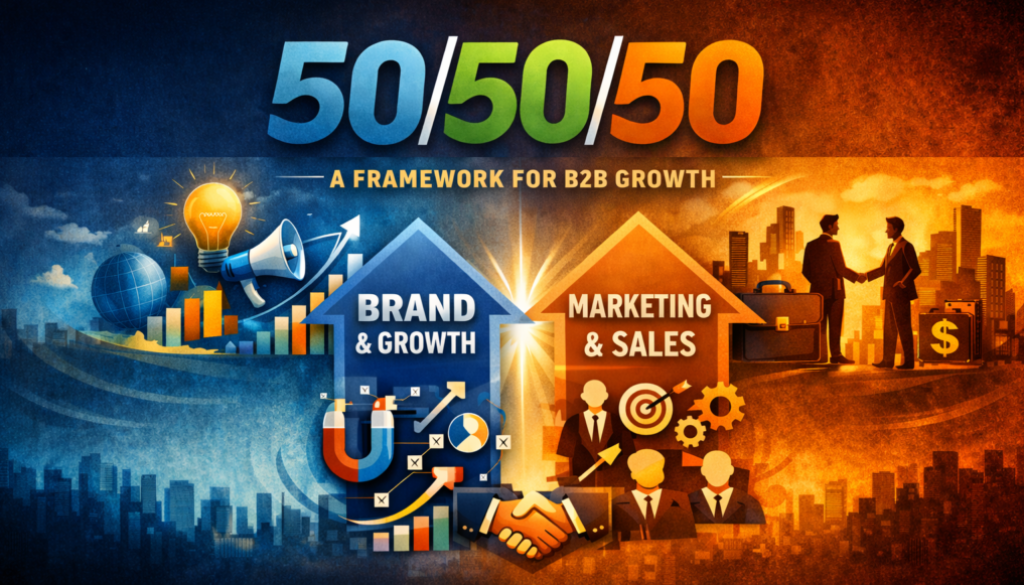
The 50/50/50 Model: A Practical B2B Growth System
Growth is hard, though not for lack of growth frameworks. What we suffer from is a lack of clarity—especially when it comes to how marketing and sales are directed, funded, measured, and held accountable.
The 50/50/50 model is a deliberately simple growth model for B2B companies. While success will still ultimately be determined by execution, this framework forces alignment, eliminates excuses, and balances near-term revenue pressure with long-term enterprise value creation.
At its core, the model sets three explicit expectations:
First 50/50: The Marketing Budget
Marketing spend is split 50/50:
- 50% Brand (including PR, thought leadership, reputation, and category presence)
- 50% Growth (demand gen, pipeline acceleration, performance marketing)
This is not a philosophical position; it’s a practical one.
Why brand gets half the budget?
Brand is not “nice to have” in B2B. It is the mechanism by which:
- Buyers reduce perceived risk
- Sales cycles shorten
- Pricing power increases
- CAC declines over time
Companies that underfund brand typically don’t notice the damage immediately. They feel it later when win rates erode, deals stall in “no decision,” and sales leaders ask why every opportunity feels like a cold start.
PR and earned media matter here because they create credibility that cannot be purchased through ads or SDR outreach. When brand is strong, sales conversations begin at a higher altitude.
Why growth still gets half?
At the same time, marketing cannot disappear into long-term abstractions. Pipeline matters. Revenue matters. The growth half of the budget is accountable for:
- Lead creation
- Pipeline contribution
- Acceleration of in-market demand
This split forces marketing leadership to manage the inherent tension between short-term performance and long-term equity—rather than optimizing for one at the expense of the other.
Second 50/50: Who Generates Growth
Marketing is responsible for 50% of growth.
Sales is responsible for the other 50%.
This expectation is where the model does its real work.
Marketing’s 50%
Marketing is accountable for generating half of the company’s growth engine. That includes:
- Net-new leads
- Marketing-sourced pipeline
- Expansion influence in existing accounts
This is not about vanity metrics. If marketing wants a seat at the executive table, it must own a material share of revenue outcomes—not just activity.
Sales’ 50%
Sales, however, does not get to outsource its success to marketing.
Sales are explicitly expected to generate the other half of growth through:
- Prospecting
- Relationship development
- Partner channels
- Personal networks and referrals
This eliminates the most corrosive dynamic in B2B organizations: sales teams that wait for leads and complain when they don’t like the flavor.
No order-taking benchwarmers. No passive pipelines. No blaming marketing for quota misses.
The Third 50: Expectations and Behavior
The final 50/50 is less explicit but more important.
The model creates balanced expectations:
- Marketing is not a cost center; it is a growth engine with long-term and short-term responsibilities.
- Sales is not a downstream function; it is an active creator of demand.
When both functions know exactly what they are responsible for, several things happen:
- Finger-pointing declines
- Planning becomes more realistic
- Investment decisions improve
- Talent standards rise
Sales leaders hire hunters, not waiters. Marketing leaders invest like operators, not brand romantics.
Why the 50/50/50 Model Works
The model succeeds because it aligns incentives with reality.
B2B buying is nonlinear, reputation-driven, and risk-averse. Brand matters more than most revenue dashboards acknowledge. At the same time, growth does not happen without disciplined execution and shared accountability.
The 50/50/50 model:
- Balances near-term revenue with long-term value creation
- Forces sales and marketing parity, not hierarchy
- Makes expectations explicit instead of implied
Most importantly, it replaces vague collaboration rhetoric with a concrete operating agreement.
A Final Thought
This model will make some people uncomfortable. That’s a feature, not a bug.
Marketing leaders who want credit without accountability will resist it. Sales leaders who prefer to wait for leads will resist it. Organizations addicted to short-term metrics will resist it.
But for executive teams serious about sustainable B2B growth, the 50/50/50 model does something rare: it turns alignment from a slogan into a system.